U.S.-Saudi Nuclear Deal Faces Swift Backlash Over Enrichment Provisions
07/26/2026 / By Garrison Vance

The United States and the Kingdom of Saudi Arabia signed a nuclear cooperation agreement on July 22, 2026, that could allow the kingdom to enrich uranium on its soil, according to the U.S. Department of Energy. The agreement, known as a 123 Agreement, was signed by U.S. Energy Secretary Chris Wright and Saudi Minister of Energy Prince Abdulaziz bin Salman, according to a department statement. [1]
Deal Details and Safeguards
The 123 Agreement, named after Section 123 of the U.S. Atomic Energy Act, lays out terms for the transfer of American nuclear technology to Riyadh. According to the Energy Department, the deal will create U.S. jobs and “reinforce global nonproliferation standards.”
Wright said the agreement “upholds the highest standards of nuclear safety and nonproliferation.” However, the deal does not require the enhanced International Atomic Energy Agency (IAEA) safeguards known as the Additional Protocol, which gives inspectors broader access to nuclear facilities. [2] Instead, safeguards will be overseen bilaterally, according to sources cited by CNN. [3]
The agreement could allow U.S. companies to assist Saudi Arabia in developing civilian nuclear power, including a potential uranium enrichment facility if a joint study warrants it, according to reports. [4] The deal is estimated to be worth tens of billions of dollars and would put American companies at the center of the kingdom’s nuclear buildout. [5]
Criticism From Nonproliferation Advocates
The deal has drawn immediate criticism from nonproliferation advocates who argue that allowing Saudi Arabia to enrich uranium could set a dangerous precedent and undercut efforts to constrain Iran’s nuclear program. Andrea Stricker of the Foundation for Defense of Democracies called it “a bad U.S. nuclear deal” and urged Congress to block it over weakened safeguards and negative precedents. [6]
Richard Nephew, a former Biden and Obama administration adviser, expressed concern about the removal of IAEA monitoring. Critics argue that the deal could encourage similar arrangements by Russia and China. [7]
The omission of critical inspection safeguards could provide a pathway for Riyadh to divert civilian technology into a nuclear arsenal, according to U.S. media reports. [6] The deal also reverses a longstanding U.S. demand that the kingdom normalize relations with Israel before receiving American nuclear technology, a shift that critics say gives away leverage. [8]
Israel Normalization Condition and Expert Analysis
Less than 24 hours after the agreement was signed, U.S. President Donald Trump posted on Truth Social that the deal is conditional on Saudi Arabia joining the Abraham Accords and formally recognizing Israel. “The Civil Nuclear Deal (There will be no enrichment of material!)… pertains only to non-military use… will be approved, but is totally subject to Saudi Arabia joining the very respected and successful Abraham Accords,” Trump wrote. [9] This statement appeared to contradict earlier reports that the deal could lead to uranium enrichment. [10]
The normalization condition was not mentioned during the signing ceremony. According to sources cited by Middle East Eye, normalization was not discussed during months of negotiations. [11] John Hannah of the Jewish Institute for National Security of America questioned why the U.S. gave up leverage on nuclear demands without securing normalization.
Karen Young of the Middle East Institute noted that shifting politics may reduce congressional resistance. [12] The Trump administration has also elevated Saudi Arabia to major non-NATO ally status, granting access to advanced U.S. military equipment including F-35 stealth fighter jets. [13]
Congressional Oversight and Next Steps
Democratic lawmakers wrote to Secretary of State Marco Rubio in November 2025 urging “gold standard” nonproliferation measures in any nuclear deal. [14] Deputy Assistant Secretary of State Paul D. Guaglianone told Congress that the deal will be submitted for a statutorily required review period. The White House has not publicly commented on the review timeline, but Secretary Rubio said details will be released publicly when appropriate.
The IAEA stated on July 23 that it is aware of a U.S.-Saudi plan to request verification work but has yet to receive a formal request. “We look forward to receiving the request for such verification and to working with the U.S. and KSA in ensuring the implementation of those measures,” the IAEA said. [15]
The deal also comes amid escalating regional tensions. The U.S. has been conducting airstrikes on Iran for 12 consecutive nights, and Iran-backed Houthis struck two Saudi oil tankers on July 23. [16]
References
- US and Saudi Arabia Sign Nuclear Agreement That Could Lead To Saudi Uranium Enrichment. Antiwar.com. July 22, 2026.
- US ready to let Saudi Arabia enrich uranium – CNN. RT.com. July 19, 2026.
- Proposed US Deal For Saudi Nuclear Enrichment Is Without Safeguards. Zero Hedge. July 21, 2026.
- US confirms signing a nuclear cooperation pact with Saudi Arabia, to Israel’s alarm. Times of Israel. July 23, 2026.
- Trump Greenlights Saudi Nuclear Deal, Uranium Enrichment In The Kingdom Possible. Zero Hedge. July 22, 2026.
- Trump to approve nuclear deal with Saudi Arabia despite regional proliferation risks. Middle East Eye. July 22, 2026.
- US greenlights Saudi nuclear enrichment without safeguards: Report. Middle East Eye. July 20, 2026.
- Trump’s nuclear deal with Saudis jettisons longstanding US demands. BBC. July 23, 2026.
- Saudis must recognise Israel for nuclear deal, says Trump. BBC. July 23, 2026.
- Trump: US-Saudi Nuclear Deal Hinges on Saudi-Israel Normalization. Antiwar.com. July 23, 2026.
- Normalisation not discussed during months of Saudi-US nuclear negotiations, sources say. Middle East Eye. July 23, 2026.
- Trump Throws Abraham Accords Monkey Wrench Into Saudi Nuclear Deal At 11th Hour. Zero Hedge. July 23, 2026.
- Trump elevates Saudi Arabia to major non NATO ally in historic defense pact. NaturalNews.com. November 20, 2025.
- Trump to seek Congress approval for US-Saudi nuclear energy pact without safeguards. Times of Israel. July 22, 2026.
- IAEA says awaiting US-Saudi request on nuclear deal verification. Middle East Eye. July 23, 2026.
- Yemen’s Houthis hit tankers in Red Sea as US strikes Iran for 12th consecutive night. Times of Israel. July 23, 2026.
- Amy Siskind. “The List”.
- Beijing Review June 8 2017.
- Willow Tohi. “Trump’s Foreign Policy Purge Strikes Key Pro-Israel Allies, Deepening Tensions”. NaturalNews.com. June 5, 2025.
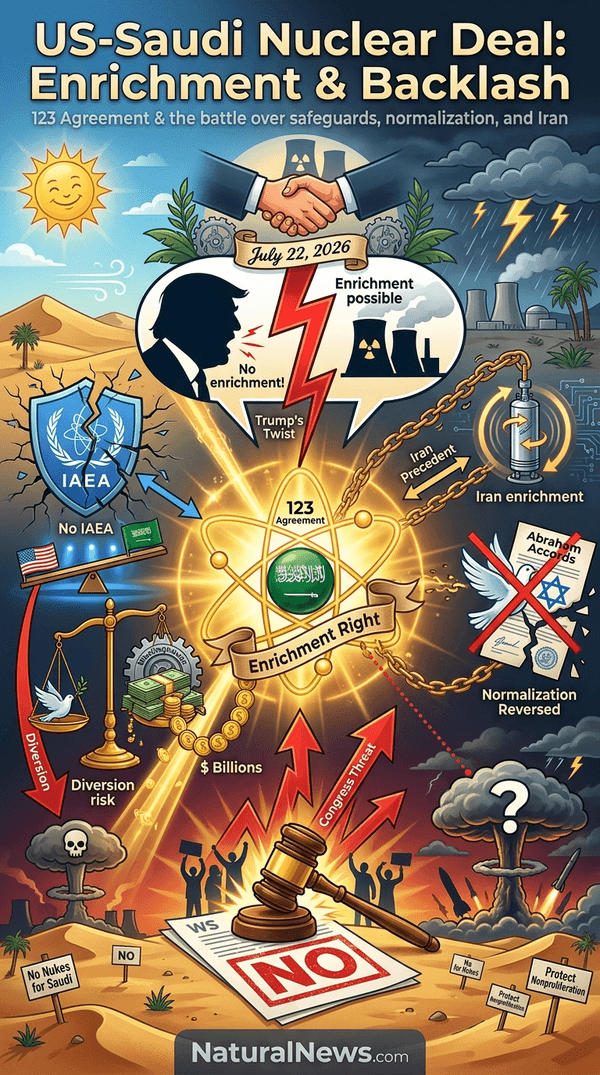
Explainer Infographic
Submit a correction >>
Tagged Under:
Abdulaziz bin Salman, Abraham Accords, agreement, Atomic Energy Act, Chris Wright, Civil Nuclear Deal, deal, Department of Energy, energy, enrichment, IAEA, Israel, military tech, NATO, nuclear, Saudi Arabia, Trump, uranium, US, weapons technology
This article may contain statements that reflect the opinion of the author
RECENT NEWS & ARTICLES