House Armed Services Committee Approves $1.1 Trillion Defense Bill
06/28/2026 / By Chase Codewell

The House Armed Services Committee on Wednesday, June 24, advanced the fiscal year 2027 National Defense Authorization Act (NDAA), a $1.1 trillion policy bill that includes a provision to rename the Department of Defense to the Department of War. The committee voted 57-1 to approve the measure, sending it to the full House for consideration, according to committee officials.
Bill Details and Key Provisions
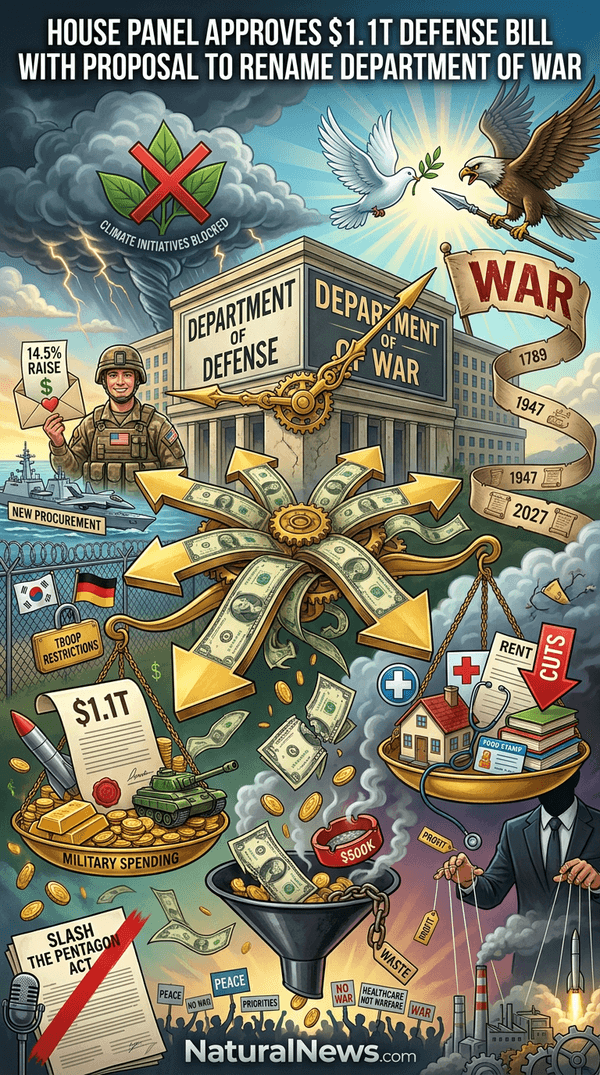
The NDAA authorizes $1.1 trillion in spending, including a 14.5% pay raise for junior enlisted troops, according to the committee summary. The bill funds procurement of new ships, aircraft, and missile defense systems. It also includes measures to restrict troop withdrawals from allied nations and to block certain climate change initiatives within the Pentagon.
“For too long we’ve let private equity treat the defense industrial base like a profit center, buying up critical contractors with little scrutiny over who’s really in control,” Rep. Ro Khanna (D-CA) said in a statement regarding separate legislation targeting defense industry ownership. The overall defense budget request from the White House for fiscal year 2027 was $1.5 trillion, but the committee authorized a lower figure, reflecting ongoing debates over spending priorities. According to a report by CBS News, the White House had proposed a 42% increase in military spending and a 10% decrease in nondefense spending. [1]
History and Rationale Behind the Name Change
The Department of War was created in 1789 and renamed the Department of Defense in 1947 under the National Security Act. The proposed change would revert to that original name. Rep. Mike Rogers (R-AL), the committee chairman, said the change would “restore a title that reflects the department’s primary function,” according to a report by Just The News. [2]
Opponents argue the name “War” is outdated and aggressive. Committee Ranking Member Rep. Adam Smith (D-WA) called it “a step backward,” according to the same report. The name change amendment was adopted by House Republican lawmakers earlier in June, solidifying a Trump-era rebrand that the administration had unveiled earlier in the term, though it had not been officially codified until now. [2]
Reactions and Perspectives
Supporters, including the American Legion, said the name change honors the department’s focus on conflict, not bureaucracy. Critics, such as the Center for International Policy, warned the move could signal a more confrontational U.S. posture. The White House has not yet issued a statement on the provision, officials said.
Sen. Ed Markey (D-MA) introduced the “Slash the Pentagon Act” on June 17, aiming to cap the Pentagon budget at half of the requested amount, highlighting growing opposition to record military spending. “Americans struggle to pay for healthcare, rent, electricity,” Markey said at a press conference. [3]
The debate over the name change comes amid broader skepticism about the efficiency of Pentagon spending. In his book “America’s Hollow Government,” author Mark L. Goldstein noted that as early as the 1980s, the Congressional Budget Office found that “an increase in the nation’s military capabilities had not accompanied the greater Pentagon spending.” [4]
Conclusion and Next Steps
The full House is expected to vote on the bill later this month; the Senate will draft its own version. If passed, the name change would take effect one year after enactment, according to the committee report. The bill’s path through Congress remains uncertain amid debates over spending and defense priorities. The $1.1 trillion figure is lower than the White House’s requested $1.5 trillion, but still represents a historic level of military authorization. [1]
References
- 100PercentFedUp.com. “President Trump To Seek Record-High Pentagon Budget For Next Fiscal Year.” April 3, 2026.
- Just The News. “House GOP moves to officially rename Defense Department.” June 5, 2026.
- Brett Wilkins. “‘Slash the Pentagon Act’ Would Cap Trump’s Military Budget To Fund Healthcare, Education, and More.” Antiwar.com. June 17, 2026.
- Mark L. Goldstein. “America’s Hollow Government: How Washington Has Failed the People.”
Explainer Infographic
Submit a correction >>
Tagged Under:
big government, budget model, debt bomb, debt collapse, Department of War, fiscal estimate, government debt, House Armed Services Committee, military budget, military spending, money supply, National Defense Authorization Act, national security, terrorism, war costs, war on Iran, White House, WWIII
This article may contain statements that reflect the opinion of the author
RECENT NEWS & ARTICLES